Content Menu
● Understanding Integrated Powder Management
>> What is Integrated Powder Management?
>> Significance Across Industries
● The Central Role of Powder Hoppers in Powder Management
>> What are Powder Hoppers?
>> Key Functions of Powder Hoppers
>> Why Powder Hoppers are Indispensable in Integration
● Design Features That Enhance Hopper Performance
>> Material Selection and Construction
>> Hopper Geometry and Flow Dynamics
>> Sealing and Dust Control
>> Integration with Automation Technology
● Technologies Driving Innovation in Powder Hopper Systems
>> Automated Feeding and Dispensing
>> Modularity and Customization
>> IoT and Smart Monitoring
>> Anti-clogging Technologies
● Implementing Integrated Powder Management with Powder Hoppers
>> Step 1: Assessment of Powder Characteristics
>> Step 2: Designing the System Layout
>> Step 3: Automation and Control Integration
>> Step 4: Maintenance and Cleaning Protocols
>> Step 5: Safety Measures and Compliance
● Benefits of Using Powder Hoppers in Integrated Management Systems
>> Improved Process Efficiency
>> Enhanced Product Quality
>> Safety Enhancement
>> Cost Savings
● Challenges and Solutions in Powder Hopper Integration
>> Powder Cohesion and Bridging
>> Dust Generation and Contamination
>> Sensor and Control Failures
● Future Trends in Powder Hopper Technology
>> Advanced Materials and Coatings
>> Fully Autonomous Powder Management
>> Sustainability Focus
● FAQs on Integrated Powder Management and Powder Hoppers
In modern manufacturing and processing industries, managing powders efficiently is a critical component that influences quality, productivity, and safety. Powder materials, used across pharmaceuticals, chemicals, food production, and metallurgy, require precise handling from storage to processing stages. Among the vital equipment in this supply chain are powder hoppers—specialized containers designed to store, measure, and dispense powders reliably and accurately.
This article explores how integrated powder management relies heavily on powder hoppers, their functionality, design features, and the technological innovations that enhance their role in industrial operations.

Understanding Integrated Powder Management
What is Integrated Powder Management?
Integrated powder management refers to the systematic approach to handling powders within manufacturing or processing environments. It ensures smooth transitions from raw material intake, storage, dosing, to the final processing stages without contamination, material loss, or inefficiency. Integration means each stage communicates and works synchronously, often controlled through automated systems.
Effective powder management focuses on:
- Maintaining powder integrity and quality
- Minimizing waste and product loss
- Ensuring precise dosing and blending
- Enhancing safety by preventing dust explosion risks
- Improving process efficiency and traceability
Significance Across Industries
Powders are essential materials in many sectors such as:
- Pharmaceuticals: For tablets, capsules, and powders where dosage accuracy is crucial.
- Food and Beverage: Ingredients like flour, spices, and additives require hygienic and accurate handling.
- Chemical Manufacturing: Precise mixing and dosing influence product quality and safety.
- Metallurgy: Powdered metals used in additive manufacturing demand controlled environments.
Failing to manage powders properly leads to operational downtime, health hazards, and product quality issues.
The Central Role of Powder Hoppers in Powder Management
What are Powder Hoppers?
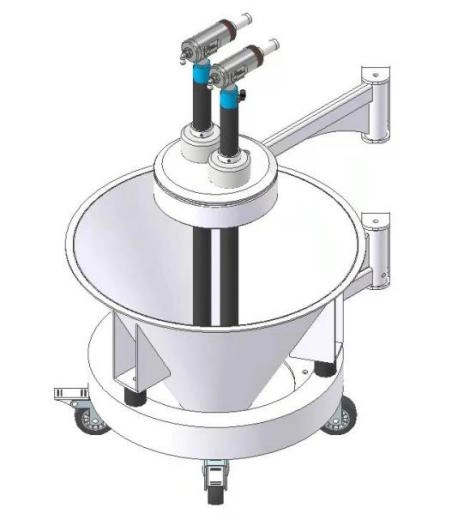
A powder hopper is a container designed to hold powders temporarily during processing stages. They come in various sizes, shapes, and materials depending on the application and type of powder handled. Their primary functions are storage, controlled dispensing, and serving as intermediaries between processing equipment.
Key Functions of Powder Hoppers
- Storage and Buffering: They hold powder quantities between processes, balancing supply and demand fluctuations.
- Controlled Dispensing: Equipped with valves or feeders, they regulate powder flow precisely.
- Mixing and Agitation: Some designs feature internal agitators to prevent powder clumping or segregation.
- Ensuring Cleanliness and Contamination Control: Proper sealing and material selection reduce contamination risks.
Why Powder Hoppers are Indispensable in Integration
In integrated systems, powder hoppers serve as the pivotal connection points. They interface with automated dosing systems, sensors, and control units, enabling smooth, continuous powder flow without manual intervention.
Their ability to provide real-time feedback on powder levels and flow rates makes them critical for automated process control to maintain consistency and reduce errors.
Design Features That Enhance Hopper Performance
Material Selection and Construction
Choosing the right materials for powder hoppers depends on the type of powder and industry standards. Common materials include stainless steel (for hygiene and corrosion resistance), mild steel (cost-effective for non-food powders), and specialized coatings (anti-static, anti-stick surfaces).
Hopper Geometry and Flow Dynamics
The shape of a hopper influences powder flow characteristics. Common designs:
- Conical Hoppers: Promote gravity-assisted powder flow to prevent arching or rat-holing.
- Steep Wall Angles: Enhance free flow for cohesive powders.
- Vibrators and Agitators: Supplement flow when powders tend to compact or bridge.
Sealing and Dust Control
To maintain product integrity and meet safety regulations, hoppers often include:
- Sealed lids and flanges keep powders uncontaminated.
- Dust removal systems prevent airborne particulates.
- Pressure relief valves to minimize explosion risks in volatile powders.
Integration with Automation Technology
Advanced powder hoppers incorporate sensors such as:
- Load cells to measure powder weight.
- Ultrasonic or laser level sensors for volume detection.
- Flow meters to monitor dispensing rates.
- These sensors feed data to PLC or SCADA systems providing real-time control.
Technologies Driving Innovation in Powder Hopper Systems
Automated Feeding and Dispensing
Modern integrated powder management uses hoppers linked to automated feeders such as screw feeders, rotary valves, or vibratory feeders enabling exact dose control. These systems reduce labor costs and improve batch consistency.
Modularity and Customization
Manufacturers offer modular powder handling units that can be configured with different hopper sizes, feeding systems, and control panels tailor-made for specific powder properties and production scales.
IoT and Smart Monitoring
Connected sensors enable remote monitoring of hopper status, predictive maintenance, and data analytics, improving uptime and process optimization.
Anti-clogging Technologies
Hoppers with built-in fluidization pads or air injection prevent powders from clogging and ensure smooth discharge even with difficult materials.
Implementing Integrated Powder Management with Powder Hoppers
Step 1: Assessment of Powder Characteristics
Understand properties such as particle size, flowability, moisture sensitivity, and abrasiveness to select or design the appropriate hopper system.
Step 2: Designing the System Layout
Incorporate powder hoppers at critical points, ensuring they interface seamlessly with upstream and downstream equipment, maintaining smooth workflow.
Step 3: Automation and Control Integration
Connect hoppers with sensors and control units to automate feeding, level control, and emergency shutdowns for safety.
Step 4: Maintenance and Cleaning Protocols
Develop procedures that ensure hoppers are cleaned regularly without material cross-contamination, using CIP (cleaning-in-place) where applicable.
Step 5: Safety Measures and Compliance
Install safety features such as explosion vents, grounding for static prevention, and dust filtration systems per regulations.
Benefits of Using Powder Hoppers in Integrated Management Systems
Improved Process Efficiency
Automated powder hoppers reduce manual intervention, minimize downtime during batch changes, and maintain consistent dosing, resulting in higher throughput.
Enhanced Product Quality
Precise powder feeding ensures consistent product formulations, reducing defects and reworks.
Safety Enhancement
By controlling dust and containing powders, hoppers reduce explosion risks, respiratory hazards, and workplace contamination.
Cost Savings
Reduced waste, lower labor costs, and optimized raw material usage lead to significant savings.
Challenges and Solutions in Powder Hopper Integration
Powder Cohesion and Bridging
Some powders tend to clump causing flow blockages. Solutions include hopper design improvements like steeper angles, agitators, and fluidizing devices.
Dust Generation and Contamination
Dust can cause product loss and health risks. Proper sealing, use of filters, and dust extraction systems mitigate these issues.
Sensor and Control Failures
Sensor accuracy is vital. Regular calibration and integration of redundant systems ensure reliability.
Future Trends in Powder Hopper Technology
Advanced Materials and Coatings
New surface treatments to further reduce powder adhesion and wear resistance are emerging.
Fully Autonomous Powder Management
AI-powered systems for self-optimizing powder flow and predictive maintenance are in development.
Sustainability Focus
Designs that enable easy recycling of powders and reduce energy consumption will gain prominence.
FAQs on Integrated Powder Management and Powder Hoppers
1. What types of powders are best suited for powder hoppers?
Powder hoppers are versatile and used for free-flowing, cohesive, hygroscopic, and even abrasive powders, but designs vary based on powder properties.
2. How do powder hoppers prevent contamination?
They use sealed construction, hygienic materials, and closed transfer systems to limit exposure to contaminants.
3. Can powder hoppers be customized?
Yes, based on capacity, shape, material, and integrated technology to suit different industrial applications.
4. What safety measures are important in powder hopper use?
Grounding for static electricity, explosion vents, dust extraction, and proper sealing are essential safety features.
5. How does automation improve powder hopper efficiency?
Automation enables precise control over powder dispensing, real-time monitoring, and reduces manual error and labor costs.
Hot Tags: China, Global, OEM, private label, manufacturers, factory, suppliers, manufacturing company





 CALL US ANY TIME









 Tel: +852 2363 2511
 Fax: +852 2764 0105
 E-mail:

 .
. 